

If you think reading one more ebook, taking one more course, or publishing one more article is going to be the thing that unlocks everything for you, then you’re going to be sorely disappointed.
You already know enough.
You already have everything you need.
You are the key that unlocks everything.
The only thing you’re missing is an identity shift. Your identity is still hovering around “I’m a beginner,” and it’s time for you to move up a level with a new, clear vision of yourself.
Even if you understand marketing, have sold some ebooks, and built an audience, you can still be stuck in beginner mode because it’s not a financial level. It’s a state of being.
Here’s how to tell if you’re stuck at this level:
1. You’re constantly looking for the “right” strategy
We all do it. We see Joe Schmoe’s product launch, and he just happens to be selling the solution to the very problem we have.
But Joe Schmoes and their product launches are a dime a dozen. There’s a new launch every day!
I’m not saying there aren’t valuable lessons to take away from Joe’s products. The problem is using them as an excuse to not do something. You might say to yourself, “I’m going to wait to create the thing I planned on creating because Joe’s course might teach me something new I need to know.”
You tell yourself you can’t move yet because you might have to start over, and it wouldn’t be worth it. But that’s just an excuse because there’s always something new. You think you’re learning, but you’re just procrastinating.
2. You talk like a beginner
Saying, “I’m just trying this out”, or “It’s just an experiment, no big deal.” is fine when you truly are a beginner. But once you’ve gained enough experience, it’s time to embrace yourself as someone who’s qualified to be a professional content creator.
Being a beginner is safe and comfortable because you don’t have any responsibilities for your results at that stage. “I’m still learning!” you tell yourself.
3. You build in public without ownership
This was a tough pill for me to swallow. I have been building on someone else’s land for the past several years. I started on Twitter (it was still Twitter then), then on Medium and Substack.
These are excellent platforms to find an audience and gain a little attention. But ideally, you want to direct those people to something you own such as an email list, a community, or a website.
It’s always a little dangerous to build on rented land because those landlords are free to kick you out at any time. I’ve been caught in Medium’s spam filter a couple of times and my account was shut off. Luckily, I was able to clear things up with them quickly both times, but it’s scary to see all your hard work disappear in an instant.
I’ve seen plenty of people over the years lose everything because they relied on someone else’s platform.
4. You pivot to a new strategy when things get uncomfortable
This is how people who are about to hit success sabotage themselves. And I confess…I do it all the damn time.
It’s that feeling you get when you get a little uncomfortable. Maybe there’s work you’re doing that’s boring. Maybe you get a nasty comment and it derails you, or your unsubscribes go through the roof. Instead of riding through the discomfort, you question your abilities and then seek out something new to focus on.
I recently learned about something called Kelley and Connor’s Emotional Cycle of Change, which was developed by psychologists Don Kelley and Daryl Connor in the 1970s. It perfectly demonstrates the emotional turmoil we go through as we try to make any kind of change in our lives.
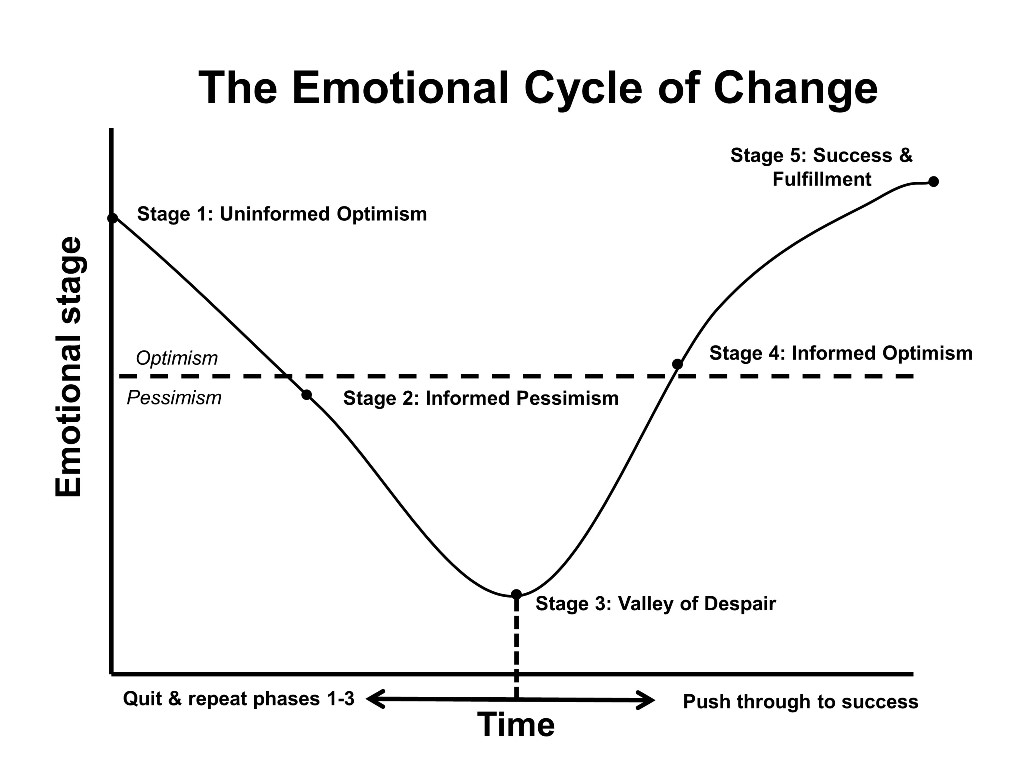
- Stage 1: Uninformed optimism → You’re going to make a change, and you’re excited about it. You’re blissfully unaware of what it takes to make this change, but you just know you’re going to do it this time.
- Stage 2: Informed pessimism → Unfortunately, the uninformed optimism doesn’t last long. Pessimism quickly sets in once you realize the reality of the change. “This is going to be harder than I thought.”
- Stage 3: Valley of despair → This is the lowest point in the emotion cycle where people usually give up. (Raises hand.) The pain of change outweighs the benefits that are so, so far away. To relieve this pain, you quit. “Life was fine before. Why did I even try to change?” And then you’re back to square one. But if you persevere through this stage…
- Stage 4: Informed optimism → The possibility of success increases and you’re back to feeling positive about the changes you’re making.
- Stage 5: Success and fulfillment → You get to fully experience the benefits of the changes you’ve made. Your new actions and behaviors used to feel uncomfortable, but now they’re just a routine part of your day.
Here’s a video that goes through each stage in detail:
If you continuously quit between stages two and three, you will never leave the beginner stage. So if you’re stuck, it’s likely not a strategy problem. It’s an identity problem. You continue to identify as a beginner, and:
- Your identity drives your behavior.
- Your behavior drives your results.
But there’s great news. You can change your identity. And once you do, your results will change. Let’s talk about how…
1. Stop saying you’re “just” anything
I’m calling myself out here because I always say I’m “just” a lowly housewife pretending to be a writer. Or I’m “just” a blogger. I’m “just” experimenting, and I don’t care about the results. If I’m honest, it’s a way to let myself off the hook.
When you say you’re “just” something, you keep yourself stuck in the beginner phase. Instead, come up with a quick and easy way to identify yourself. Examples:
- I’m a content creator.
- I’m an online writer.
- I’m a marketer and writer.
- I create online digital assets.
Keep it simple, but believable to your own mind. Don’t say “I’m a New York Times bestselling author” if that hasn’t happened yet.
2. Act from the new version of you now
If you act as if you’re a professional content creator writing for your 1,000 True Fans in your little weird corner of the internet, you will feel as if you’re already a success. And once you have that feeling down, you’ll naturally start attracting those fans.
That’s because your mind will start giving you ideas of what type of content to create that will attract them. Since you’ll be creating from a higher level, you’ll get a higher level of audience.
This won’t happen automatically. But keep creating from this viewpoint, and watch what happens…
4. Set a timeframe (and don’t change it!)
Give yourself 90 days to embody this new version of yourself. For only 90 days, you will be the higher-level creator you imagine yourself to be. After that time is up, you can evaluate the results. But don’t stray until then.
Get through the Emotional Cycle of Change before trying to pivot.
3. Build one asset
Before your 90 days are up, build one small asset to put on Gumroad to sell. It can be a guide, mini-ebook, calendar, chart, or anything that will help your ideal audience.
You can use my affiliate link to grab this ebook, $7 Problems, which will help you understand how to create a tiny asset that solves one problem. It’ll show you how to keep it useful, but also keep it simple.
When you build an asset, it’ll be confirmation that you’ve changed your identity and you’re no longer in beginner mode.
4. Collect evidence you’re someone new
The hardest thing about changing yourself if that, at the beginning, you don’t have any evidence that you’ve changed. But the evidence will start to come. And when it does, collect it and store it somewhere.
I used to do this when I first started writing on Medium. Any time I got a comment that someone loved my writing, I would screenshot it and save it in a folder. Soon, I had plenty of comments saved up. That helped me see that I could write in a way that connected with people. It’s a good resource to go back to when I slip back into doubting myself.
You’ll appreciate having that evidence, especially when you’re stuck in the Valley of Despair, wanting to quit again.
Final thoughts
There’s nothing shameful about being in beginner mode. Every skill, every career, every success story starts there. The difference is that some people eventually decide they’re no longer beginners.
Beginner mode feels safe. You’re “just experimenting.” You’re “still figuring things out.” There’s no real pressure, no real risk, no real exposure. But that safety has a hidden cost…you stay stuck, circling the same starting line.
As long as you see yourself as someone who is merely trying, you never fully own your results. And without ownership, progress is slow, inconsistent, or nonexistent.
At some point, the comfort of the beginning becomes the very thing holding you back.
That point is sooner than you think.
It’s time to move beyond the beginner stage. Choose a clear identity…not a goal, not a wish, but a decision about who you are. Then, for the next 90 days, operate from that identity. Work, think, and make choices as that version of you.
Watch what changes when hesitation is no longer part of the role you play.